Hydrogeology (Aquifer Characterisation) & Contaminated Land Projects
Overview of studies:
Albian-Geo provides hydrogeology, aquifer characterisation, contaminated-land and groundwater-risk support based on project experience in the UK and Iraq.
Work has included aquifer vulnerability assessment, groundwater-level analysis, nitrate-source interpretation, landfill leachate assessment, contaminant breakthrough modelling, water-resource planning, managed aquifer recharge review and groundwater investigation design.
The common objective is to understand how groundwater moves through variable ground, how water quality may be affected, and where further investigation is required before confident project decisions can be made.
Shallow groundwater can affect excavation stability, foundation design, dewatering, contamination migration, buried services, drainage performance, settlement, waterlogging and construction risk. Understanding groundwater depth, seasonal variation, perched water and hydraulic connectivity is therefore a core part of practical site characterisation
Key Capabilities

Aquifer Characterisation and Groundwater Conceptual Modelling
Assessment of aquifer systems, groundwater flow controls, recharge pathways, hydraulic boundaries, aquifer continuity, transmissivity, storage, anisotropy and uncertainty to support water-resource, development and contamination-risk decisions

Groundwater Monitoring, Testing and Data Interpretation
Design and interpretation of groundwater monitoring, aquifer testing and hydrochemical datasets, including groundwater-level response, hydrograph behaviour, pumping tests, recovery monitoring, injection testing, downhole logging and water-quality sampling
_JPG.jpg)
Contaminated Land and Groundwater Risk Assessment
Evaluation of contaminant sources, pathways, receptors, groundwater migration mechanisms, leachate behaviour, hydrochemical evidence, toxicity indicators and uncertainty in contaminated-land settings

Managed Aquifer Recharge, Water Harvesting and Groundwater Storage Review
Assessment of aquifer suitability for managed aquifer recharge, seasonal recharge, surface-water infiltration, groundwater mounding, sediment clogging, salinity mobilisation, waterlogging risk and recoverable groundwater storage

GIS, Remote Sensing and Spatial Hydrogeological Analysis
Integration of geology, drift cover, soils, slopes, nitrate distribution, imagery, DEMs, borehole records and hydrochemical information to identify spatial patterns, vulnerability zones and groundwater investigation priorities

Water-Resource Planning and Investigation Design
Development of staged groundwater strategies based on measured aquifer performance, including screening of water-source horizons, design of targeted field investigations, planning of pumping wells, monitoring wells and injection test wells, and identification of critical knowledge gaps


Penrith Sandstone Aquifer
Project undertaken with British Geological Survey (Wallingford) and part of elevated nitrate study:
Long-term groundwater-level records were analysed using polynomial type curves, autocorrelation and GIS layering to identify spatial differences in aquifer response, recharge behaviour and potential nitrate-vulnerability zones
-
The Penrith Sandstone is known for variable fracturing and cementation, which affects flow and transport.
-
Nitrate behavior is highly sensitive to residence time, flow pathways, and mixing — all of which could be inferred indirectly through hydrograph shape.
-
Identifying spatial zones with distinct polynomial shapes might correlate with areas of rapid recharge (fracture-dominated) vs. slow, diffuse infiltration (matrix-dominated), and help partition the source zones of nitrate
Polynomial Analysis and Type Curve Revision
Three standard curve types identified
Varying well level response and phase changes
Hydrograph property / Possible process implication
-
Flashy response after rainfall
-
Rapid recharge, thin drift, fracture/bypass flow, permeable soils
-
-
Delayed response
-
Vadose-zone damping, storage effects, longer recharge pathway
-
-
Large annual amplitude
-
Strong seasonal water-table cycling or storage-controlled response
-
-
Small annual amplitude
-
Buffered aquifer response or higher transmissivity/storage smoothing
-
-
High polynomial R squared but weak rainfall correlation
-
Long-memory system, indirect recharge, confinement/backing-up, or regional control
-
-
Low polynomial R squared but stronger rainfall correlation
-
More event-responsive, less smoothed recharge behaviour
-
Autocorrelation of well levels
correlation
Identified two structural responses
-
Flashy - no discernible correlation
-
Fissures and by-pass flow
-
-
Steady - Monthly extending to about 27 months
-
Dampening effect caused by hard bands
-
Rain data over the same period shows a seasonal correlation
GIS Integrated Layering
Combined:
-
Geology
-
Drift
-
Soils (Aquifer vulnerability)
-
Locations of high, medium and low nitrates
-
Slopes
Spatial Analysis of the type curves
Conclusions
-
High nitrate appeared more likely where there was thin drift cover, coarser / well-drained soils, and potentially more direct recharge pathways;
-
Some low-transmissivity / high-nitrate associations may have existed;
-
But the hydrograph type curves alone did not uniquely explain anomalous nitrate values;
-
Modelling suggests land use and drift thickness are main factors for nitrate anomalies.
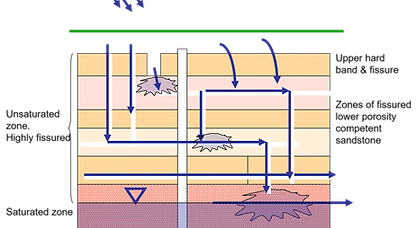
Flashy by-pass model through recharge zone

Dampened recharge response

Fissure density and recharge response - lower density higher response signature

GIS: Soils, geology nitrates and slopes Red dots are high nitrates

Manure Spreading - sources of elevated nitrates
(With thanks to Andy Butcher BGS)
Ferry Road Landfill
A diverted river meander and raised landfill in South Wales.
The landfill was developed under a dilute-and-disperse waste-management concept.
River Ely was diverted and the cut-off meander was infilled with domestic landfill material and closed in 1994.
Monitoring wells were driven along the old meander channels.
Previous history of early 20th century industrial dumping from gas-works and other local riverside industry
Separate hazardous waste cell created part way up the raised landfill.
Two separate studies were undertaken
1. Chemistry and toxicity of the leachate
The study focused on:
-
landfill history and hydrogeological setting
-
wet/dry period leachate sampling
-
major ion and trace-metal chemistry
-
field parameters: pH, Eh, EC, temperature, DO
-
DNA plasmid scission assay
-
Spearman rank correlation
-
ArcGIS Getis-Ord hotspot analysis
Conclusions
Ferry Road landfill leachate was chemically heterogeneous, hydrologically responsive, and capable of causing DNA damage in vitro.
Toxicity hotspots were spatially concentrated, particularly around the northern monitoring wells, and the toxicity pattern was not explained by a single analysed inorganic species.
The evidence supports a mixed-contaminant leachate toxicity mechanism influenced by wet/dry hydrological forcing
2. Leachate breakthrough modelling
The study included and recognised the role of:
-
palaeochannel geometry;
-
landfill construction history;
-
hydraulic containment;
-
pumping-induced gradients;
-
vertical leakage through imperfect natural barriers;
-
external legacy contamination;
-
bidirectional flow in the gravel aquifer;
-
field observations and geophysics as model support.


Interpretation of the breakthrough mechanism
The study identified two different but linked breakthrough mechanisms.
Mechanism 1: Leachate from landfill/meanders into gravels
This is the main landfill-risk pathway.
The proposed mechanism is:
-
rainfall infiltrates the capped landfill;
-
leachate drains into former meander fills;
-
meanders become damp to saturated;
-
leachate head locally increases;
-
vertical leakage occurs through thin/disturbed alluvium or imperfect clay liner;
-
conservative species enter the underlying gravels;
-
flow in the gravels transports contaminants laterally;
-
breakthrough to the River Ely or Ferry Road peninsula may occur at low concentration.
This provides a credible hydrogeological mechanism for contaminant migration.
Mechanism 2: External contaminated groundwater entering the landfill system
A more nuanced interpretation.
-
The study suggests that external legacy contamination from the gasworks / industrial land to the north or northwest could migrate towards the landfill, especially if landfill pumping induces inward gradients.
-
This means the landfill may act not only as a source but also as a hydraulic sink for surrounding contaminated groundwater.
Conclusion:
-
Ferry Road landfill is partially hydraulically controlled by pumping,
-
But the former meander geometry, damp to saturated landfill base, variable alluvium thickness, possible disturbed clay/alluvium zones, and underlying gravel aquifer create credible pathways.
-
This provides pathways for low-concentration conservative leachate species to migrate vertically and laterally.
-
Model results support possible breakthrough over decadal timescales, especially for non-sorbing species such as chloride,
-
Although the breakthrough claim remains model-supported rather than directly proven by observed concentration-time breakthrough data
The simulated leachate breakthrough after approximately 20 years provides a relevant context for the low biodiversity reported from a similar River Ely sampling area in Jüttner’s diatom study of Cardiff Bay and the inflowing Rivers Taff and Ely.
Although the ecological study did not identify a specific cause, and therefore cannot be used as direct evidence of landfill impact, the coincidence between the modelled breakthrough pathway and observed ecological degradation suggests a plausible association that would have warranted further targeted investigation.
Diatoms as Indicators of Water Quality in Cardiff Bay and the Inflowing Rivers Taff and Ely, Wales, United Kingdom (Jüttner, I.)
Post-Study Follow-up

Local news reports leachate entering the River Ely from about 2017. While possibly more operational in nature the risk was clearly identified


Bai Hassan & Mukdadiya Aquifers and Overlying Unconfined Aquifer
The project area has been assessed through a desk study of publicly available geological, hydrogeological, hydrological, topographic and remote-sensing information.
The work has focused on understanding the likely aquifer systems beneath and around the proposed development area, their potential for groundwater supply, and their suitability for managed aquifer recharge and water harvesting.
The current desk study suggests the following preliminary conclusions:
-
The project aquifer system is likely to be heterogeneous, with variable permeability controlled by alluvial sediments, channel deposits, clay-rich layers and older geological formations.
-
Shallow Quaternary deposits may provide the most direct opportunity for recharge from surface-water runoff, wadi flow and engineered infiltration systems.
-
Coarse-grained sands and gravels, where present, are likely to offer better recharge and abstraction potential than clay-rich or silty deposits.
-
Groundwater quality is expected to be variable, with salinity representing a key constraint for long-term use, irrigation suitability and managed aquifer recharge.
-
Recharge is likely to be seasonal and event-driven, rather than continuous, reflecting the arid climate and dependence on flood flows.
-
The Al-Teeb River may act as a focused recharge pathway during high-flow events, but this needs to be confirmed through field monitoring.
-
The aquifer may have useful storage potential, but recoverable storage is not the same as total aquifer volume. Specific yield, hydraulic connectivity, flow direction and water quality will control how much recharged water can be recovered.
-
Fine sediment carried by floodwater may reduce infiltration rates over time unless sediment management, settling basins or pre-treatment measures are included.
-
Reservoirs, recharge basins or infiltration systems could raise local groundwater levels, but this may also create groundwater mounding, salinity mobilisation or waterlogging risks if not properly understood.
Aquifer Testing and Water Resource Planning for Oilfield Development:
Lower Fars & Euphrates Aquifers
This work demonstrates the application of hydrogeology to operational water supply, aquifer testing, injection planning and long-term groundwater management in an oilfield-development context.
Results of desk study presented to Iraqi Northern Oil Company (NOC)
-
Review of geology, hydrogeology, topography, drainage, surface water, groundwater quality and existing water use. To include equity for local inhabitants.
-
Development of a conceptual hydrogeological model to understand likely aquifer behaviour.
-
Identification of shallow, semi-confined and confined aquifer units.
-
Assessment of potential recharge pathways, groundwater flow controls and hydraulic boundaries.
-
Review of borehole records, well logs, wireline data, satellite imagery, DEMs and hydrochemical information.
-
Screening of potential water-source horizons for yield, sustainability, water quality and accessibility.
-
Assessment of risks from drawdown, salinity, vertical leakage, aquifer interference and impacts on existing users.
-
Clear separation of known data, interpretation and remaining uncertainty.
-
Identification of critical knowledge gaps before final water-resource decisions are made.
-
Design of targeted field investigations to test the aquifer model.
-
Planning of pumping wells, monitoring wells and injection test wells.
-
Use of step-rate tests, constant-rate pumping tests, recovery monitoring, injection tests and falloff analysis.
-
Inclusion of downhole logging, water-level monitoring and hydrochemical sampling.
-
Evaluation of aquifer continuity, transmissivity, storage, anisotropy and hydraulic connection between units.
-
Development of staged groundwater strategies based on measured aquifer performance rather than assumption.
-
Refinement of abstraction, recharge, injection, monitoring and long-term aquifer management plans.